The Pale Stomach Problem Is Real
You've been tanning all week, your arms look great, your legs have color, even your shoulders are golden — and then there's your stomach. Still pale. Still looking like it belongs to a different person. Sound familiar? You're not alone. The pale stomach is one of the most common tanning frustrations, and there's actually a biological reason for it.
Stomach skin is thinner and has fewer melanocytes (the cells that produce melanin) compared to your arms, legs, and back. It also doesn't get as much casual sun exposure throughout the year since it's usually covered by clothing. So when you start actively tanning, your stomach is starting from way behind everything else.
Position Is Everything
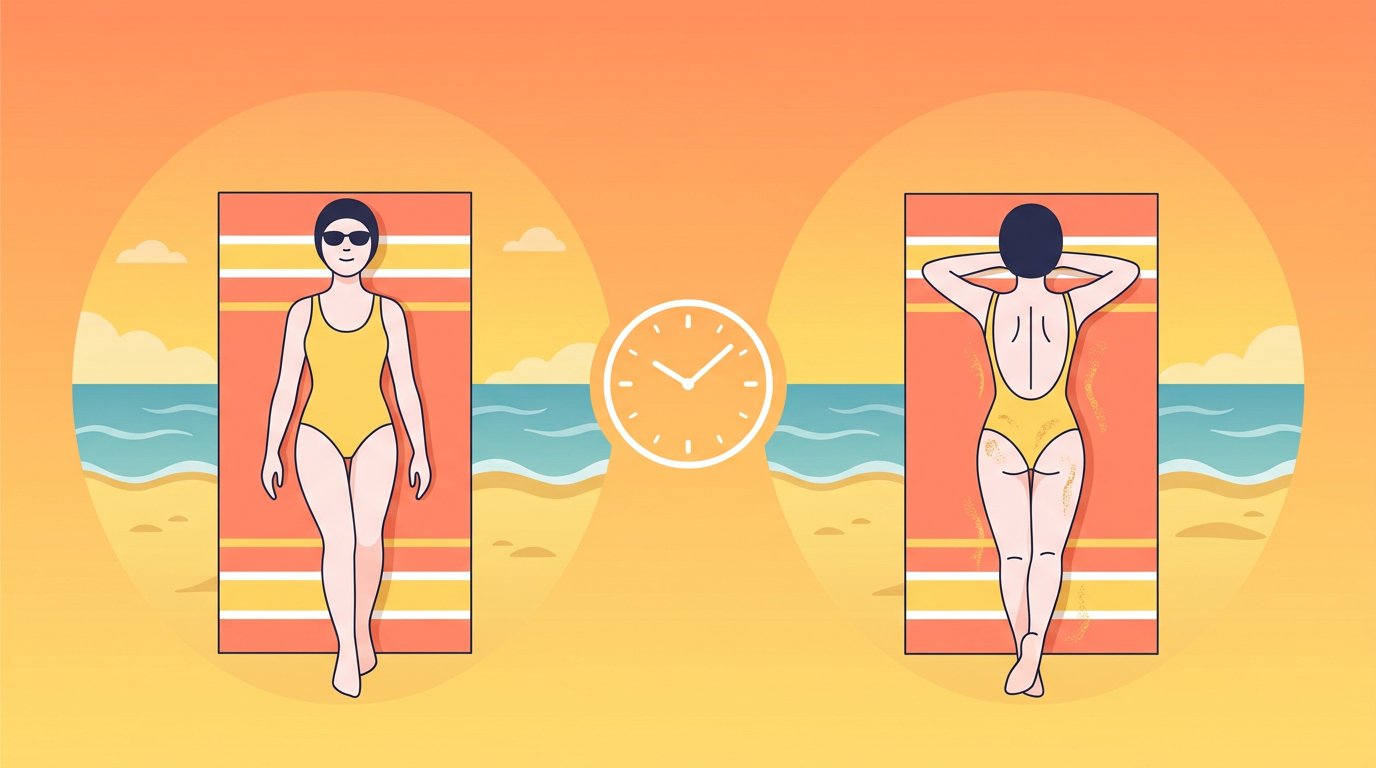
The biggest reason stomachs stay pale is simple: positioning. When you lie on your back, your stomach isn't actually facing directly at the sun unless the sun is directly overhead. If it's morning or afternoon, the sun is at an angle, which means your stomach is getting way less direct UV than your legs or chest.
To fix this, think about your angle. During morning sessions, prop your upper body up slightly so your stomach faces the sun more directly. A beach chair set to a low recline works perfectly. You want your stomach tilted toward the sun, not lying flat while the sun hits at a shallow angle.
During midday when the sun is highest, lying flat is actually fine because the UV is coming from almost directly above. This is when your stomach gets the most even, direct exposure.
Relax and Breathe
This sounds weird, but hear us out. When you're lying on your back, a lot of people unconsciously tense their stomach muscles. You're at the beach, you're in a bikini, your instinct is to suck in a little. But tensed skin creates shadows and folds that block UV from reaching certain areas evenly.
Relax everything. Let your stomach be soft and flat. Take slow, deep breaths that expand your belly. The more relaxed and smooth your stomach skin is, the more evenly UV reaches every part of it. This is genuinely one of the most underrated tanning tips out there. Nobody talks about it, but it makes a real difference.
Give Your Stomach Extra Time
Since your stomach tans slower than other body parts, it needs more focused attention. During your normal tanning sessions, make sure you're spending at least 10-15 minutes on your back with your stomach exposed and positioned well. If you normally flip between front and back, give your back side a little less time and your stomach side a little more.
Some people do dedicated "stomach sessions" where they just lie on their back for the full session. If your stomach is significantly paler than the rest of you, try this for a week and see if it starts catching up.
Exfoliate Before Tanning
Dead skin cells on your stomach can create an uneven surface that blocks UV penetration and causes patchy tanning. Before your tanning session, gently exfoliate your stomach with a soft scrub or exfoliating mitt. This removes the dead layer and allows UV to reach the fresh, melanin-producing cells underneath.
Don't go crazy with it — you're not trying to sand your skin off. A gentle scrub in the shower the morning before you tan is plenty. Follow up with a light moisturizer and let it absorb before applying sunscreen.
Moisturize Like Your Tan Depends on It
Because stomach skin is thinner, it dries out faster, and dry skin doesn't tan as well or hold a tan as long. Moisturize your stomach morning and night, and immediately after every tanning session. Aloe vera is great for post-tan, and something richer like shea butter or cocoa butter works well at night to keep your skin hydrated overnight.
Hydrated skin reflects less UV and absorbs it more evenly, which translates to a smoother, more even tan. This applies everywhere, but it's especially important for areas like your stomach that are fighting an uphill battle.
Don't Compare Body Parts
Your stomach will almost always be slightly lighter than your arms or legs. That's just how skin works — different areas have different melanocyte densities. The goal isn't to make everything perfectly identical (that's basically impossible without self-tanner). The goal is to get your stomach tan enough that the difference isn't jarring.
If you want to close the gap further, apply a light self-tanner just on your stomach on your off days. A gradual formula once or twice a week can bring it in line with the rest of your body without looking fake. Sometimes the best tan is a team effort between the sun and a little product help.
Learn more: How Long to Tan Each Side | Best Tanning Positions
The Stomach Catch-Up Plan
Week 1: Each session, give your stomach 5-10 extra minutes. SPF 50 on arms and shoulders (already darker), SPF 30 on stomach. Between sessions, gradual self-tanner just on stomach every other evening.
Week 2: Continue differential SPF. Add 2-3 minutes of dedicated stomach time at the end of each session. Within two weeks, the contrast should be dramatically reduced.
Why Stomach Skin Is Different
Fewer melanocytes per square centimeter — genetic, cannot change it. Maximize what you have through consistent UV exposure.
Less blood flow — fewer nutrients reach melanocytes. Before tanning, do gentle stomach massage or core exercises to increase blood flow.
Zero incidental UV. Your face and forearms get casual sun daily. Your stomach never sees sun unless you actively tan — always starting from zero.
Accept that your stomach will always be slightly lighter. A 90% match looks natural. Use our tanning calculator and skin type quiz. For stomach-specific sessions, add 10-15% more time than the calculator suggests.
The Sun Angle Factor for Stomach Tanning
Here is a detail that transforms your stomach tanning results: the angle of the sun relative to your stomach surface matters enormously. When you lie flat on your back during morning or late afternoon sun, the UV is coming at an angle — which means it hits your stomach at a glancing angle rather than head-on. Your chest and face, which are slightly angled upward relative to your stomach, receive more direct UV.
The fix is to adjust your body angle to match the sun angle. In morning sessions (sun lower in the east), prop your torso up slightly so your stomach faces east. In afternoon sessions (sun lower in the west), orient yourself so your stomach faces west. During midday when the sun is overhead, lying flat is actually fine because UV hits your stomach directly from above.
A beach chair set to the lowest recline position is perfect for morning and afternoon sessions — it angles your stomach at about 15-20 degrees, which lines up much better with non-overhead sun. Even propping yourself up on your elbows while reading gives your stomach significantly more direct UV than lying completely flat.
Track the time of day you do most of your tanning and adjust accordingly. If you always tan after school (3-5 PM), the sun is at a western angle — face that direction with a slight torso recline and your stomach will catch up noticeably faster than lying flat facing any random direction.
Self-Tanner Specifically for Stomach Skin
If the UV catch-up approach is not closing the gap fast enough, self-tanner applied specifically to your stomach is the shortcut that works. Here is the stomach-specific technique:
Exfoliate your stomach thoroughly. Stomach skin can be surprisingly uneven in texture, especially around the navel and waistband area. A gentle scrub creates a smooth, even surface for the self-tanner.
Moisturize the hip bones and waistband area. These spots are drier and can grab more DHA, creating dark lines. A thin layer of moisturizer on these areas before applying self-tanner prevents uneven absorption.
Apply thin, even layers. Use a tanning mitt and apply in long upward strokes from your waistband to your chest. Go LIGHTER than you think you need — you can always add a second coat the next day. Going too dark on your stomach while the rest of your body is naturally tanned creates the opposite problem.
Blend into surrounding areas. The edges where stomach meets chest, sides, and hip area need careful blending. Feather the product outward so there is no visible line where the self-tanner stops and your natural tan begins.
After 2-3 applications on alternating days, your stomach should match your naturally tanned areas closely enough that the difference is undetectable. Maintain by reapplying every 3-4 days as the DHA fades. Eventually, your ongoing UV sessions and the self-tanner work together to create a seamlessly even all-over color.
Stomach Tanning and Body Confidence
Let us address the elephant in the room: a lot of people feel self-conscious about exposing their stomach while tanning, whether it is at a public beach or even in their own backyard. Body insecurity about stomach area is incredibly common, and it can prevent people from tanning their stomach at all — which makes the pale-stomach problem worse, which makes the insecurity worse. It is a cycle.
Here is the thing: to tan your stomach, it needs sun exposure. That means showing it. If showing your stomach in public feels uncomfortable, start at home. Your backyard, a private balcony, even lying by an open window with your shirt pulled up. The sun does not care where you are. Build your stomach tan in private until you feel confident, then take it public if and when you want to.
And remember: everyone at the beach or pool is mostly thinking about themselves. The person next to you is probably worrying about THEIR stomach, not looking at yours. We are all our own harshest critics. Your stomach — at any size, any shape — has every right to see the sun. Let it catch up to the rest of your body. It will look great with a little color, regardless of what it looks like without one.