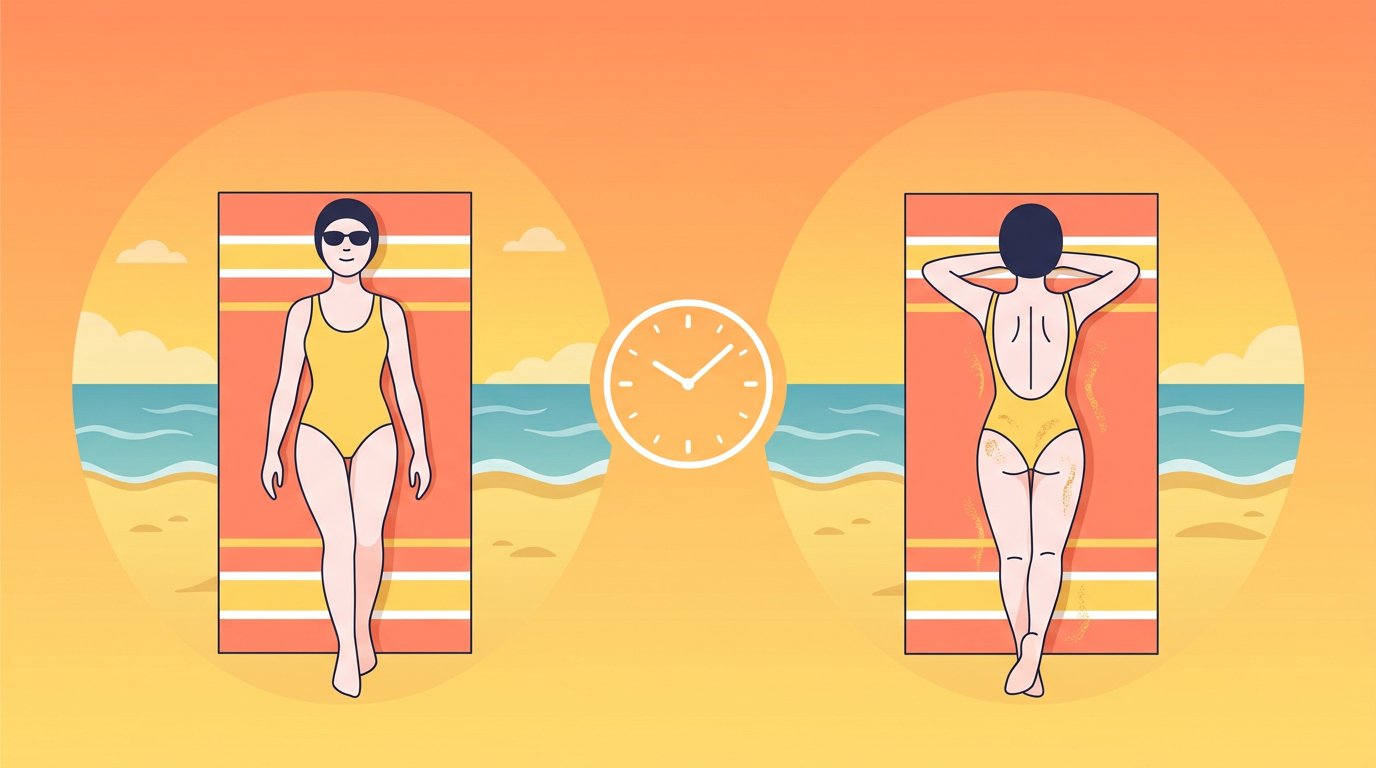
How long do you actually stay on each side before flipping? Too little and you are patchy, too much and you are a lobster. We ran the numbers through our tanning calculator for every skin type and UV level so you do not have to guess. Here are the exact times.
Per-side tanning time: the complete table
This table shows how many minutes to spend on each side (front or back) per round, based on your Fitzpatrick skin type and the current UV index. Each round means: lay on your front for X minutes, then flip and do the same on your back.
| UV Index | Type I Very Fair | Type II Fair | Type III Medium | Type IV Olive | Type V Brown | Type VI Dark |
|---|---|---|---|---|---|---|
| 3 (Low) | 5 min | 7 min | 15 min | 18 min | 18 min | 18 min |
| 4 (Moderate) | 5 min | 7 min | 15 min | 17 min | 18 min | 18 min |
| 5 (Moderate) | 4 min | 7 min | 15 min | 16 min | 17 min | 18 min |
| 6 (High) | 4 min | 6 min | 13 min | 17 min | 18 min | 19 min |
| 7 (High) | Skip | 7 min | 15 min | 16 min | 17 min | 18 min |
| 8 (Very High) | Skip | 7 min | 13 min | 15 min | 15 min | 16 min |
| 9 (Very High) | Skip | 7 min | 15 min | 16 min | 17 min | 18 min |
| 11 (Extreme) | Skip | 6 min | 8 min | 9 min | 9 min | 10 min |
How to read this: Find your skin type across the top and the current UV index down the left. The number is how many minutes to spend on your front before flipping, then the same on your back. "Skip" means the UV is too intense for safe tanning with that skin type — stay in shade or wait for a lower UV window.
Not sure what your skin type is? Take our quick skin type quiz — it takes two minutes and changes everything about how you time sessions.
Total session time: rounds, breaks, and SPF
You do not just flip once. A proper tanning session uses multiple front-back rounds with 10-minute shade breaks in between. The number of rounds depends on how long your skin can safely absorb UV. Here is the full breakdown.
| UV Index | Skin Type | Per Side | Rounds | Total Tan Time | SPF |
|---|---|---|---|---|---|
| 3 (Low) | Type I | 5 min | 6 | 60 min | SPF 50 |
| Type III | 15 min | 5 | 150 min | SPF 30 | |
| 5 (Moderate) | Type II | 7 min | 5 | 79 min | SPF 50 |
| Type IV | 16 min | 5 | 165 min | SPF 30 | |
| 7 (High) | Type II | 7 min | 4 | 63 min | SPF 50 |
| Type V | 17 min | 4 | 138 min | SPF 30 | |
| 9 (Very High) | Type II | 7 min | 3 | 42 min | SPF 50 |
| Type IV | 16 min | 2 | 66 min | SPF 50 | |
| 11 (Extreme) | Type III | 8 min | 1 | 17 min | SPF 50 |
| Type VI | 10 min | 1 | 20 min | SPF 50 |
Total tan time is front + back across all rounds (not counting breaks). Add 10 minutes between each round for shade, hydration, and sunscreen reapplication. So a 5-round session at 15 min/side = 150 min tanning + 40 min breaks = about 3 hours total. For your exact setup, use our tanning calculator — it builds a personalized routine with a step-by-step timer.
Key pattern: As UV goes up, per-side time stays roughly the same but you get fewer rounds. At UV 3, a Type III person does 5 rounds of 15 min/side. At UV 9, the same person does just 2 rounds of 15 min/side. Higher UV means shorter sessions overall, not necessarily shorter flips.
Sample session: Type III at UV 5
Here is exactly what a session looks like for a medium skin type on a typical sunny day (UV 5). This is the most common scenario for most tanners.
Round 1: 15 min on your front, flip, 15 min on your back.
Break: 10 min in shade — reapply SPF 30, drink water.
Round 2: 15 min front, 15 min back.
Break: 10 min shade.
Round 3: 15 min front, 15 min back.
Break: 10 min shade.
Round 4: 15 min front, 15 min back.
Break: 10 min shade.
Round 5: 15 min front, 15 min back.
Total: 150 min tanning + 40 min breaks = 3 hours 10 minutes. You build deep, even color across 5 cycles without overexposing any one area.
The flip: front, back, and sides
Most people just do front and back, but if you want a truly even tan, work your sides in too. Here is the rotation:
1. Start on your back. Biggest surface area, needs the most time. Keep your palms facing up so the insides of your arms get exposure.
2. Flip to your front. Same duration. Keep arms slightly away from your body to avoid white lines on your sides. Prop your chin on your hands periodically to let UV reach under your jawline.
3. Left side. About half your per-side time. Support your head with your hand and let your top leg fall slightly forward for inner thigh exposure.
4. Right side. Same deal — hips, outer thighs, and the sides of your torso that otherwise stay pale.
Set a timer on your phone for each position. Four alarms, one per rotation. It is way too easy to lose track of time.
Why Type I should skip high UV
You will notice "Skip" in the table for Type I at UV 7 and above. That is not us being cautious — it is because the math does not work. Very fair skin has such a low MED (minimal erythemal dose) that at high UV, even a few minutes of exposure causes more damage than melanin production. Type I tanners build the best color in UV 3-5 over more rounds with SPF 50. It takes longer but the results are real and lasting. Our pale skin tanning guide has the full strategy.
SPF does not stop tanning
A common myth that keeps people from using sunscreen while tanning. SPF 30 blocks a significant portion of UVB but still lets through enough UV to stimulate melanin production. You just tan more slowly and much more safely. Think of it as tanning with a safety net.
At UV 3-6 with medium-dark skin, SPF 30 is the recommendation. At UV 7+ or for fair skin at any level, SPF 50 is mandatory. Reapply every time you flip or every two hours, whichever comes first. Pay extra attention to areas that rub against your towel.
Adjusting for body parts
Not all body parts tan at the same rate because melanocytes are not distributed evenly.
Legs: Notoriously slow tanners. The skin on your shins has fewer melanocytes and is often drier. Give your legs extra direct exposure — sit up during breaks or do a dedicated leg session. See our leg tanning guide.
Face: Tans fast, ages fast. Use SPF 50 on your face every day and consider wearing a hat during body sessions. Your face gets plenty of incidental UV from daily life. More in our face tanning guide.
Stomach: Usually lighter because it is covered most of the time. When on your front, make sure it is fully flat and exposed, no bunching from how you are lying.
Feet: Tops burn surprisingly fast if neglected. Palms and soles barely tan at all. Extra SPF on the tops, do not worry about the soles.
Why rounds beat marathon sessions
Your melanocytes have a maximum production rate. After a certain amount of UV in a single continuous exposure, additional time does not produce more melanin — it just produces damage. For most skin types, melanin production peaks within about 20-40 minutes of moderate UV exposure per round.
This is why the calculator splits sessions into rounds with breaks. Each round triggers a fresh cycle of melanin activation, while the break lets your skin cool down and SPF get reapplied. Five 30-minute rounds over a few hours produces dramatically better, more even color than 150 minutes straight.
Your tan darkens 24-48 hours after exposure, not during it. If you look at your skin right after tanning and think nothing happened, give it a day. Judging results too early leads to overtanning — which leads to peeling, which destroys the color you already built.
Track your sessions for consistent results
If you are serious about an even tan, tracking sessions makes a huge difference. Note the date, UV index, how long you spent on each side, and how your skin looked the next day. After a few sessions, patterns emerge that are specific to your body.
Tan AI does this automatically — it reads real-time UV at your location, factors in your skin type, and builds a step-by-step timer with exact flip times for every session. No more guessing, no more mental math.
Building your routine
Start with shorter sessions and build up over a week or two. Three sessions in your first week with rest days between, increasing per-side time by about 2-3 minutes each week until you hit the optimal duration from the tables above. For a complete plan, check our best tan routine for your skin type.
Consistency beats intensity. Three well-timed sessions per week will always outperform one marathon session on the weekend. And with the right per-side timing, every single session builds color evenly — no patchy spots, no burns, just a steady golden glow.