The Back Tanning Struggle
Your back is probably the hardest part of your body to tan evenly — especially if you're tanning solo. You can't see it, you can't reach all of it easily, and sunscreen application is a mess. We've all been there: gorgeous tan on the front, patchy disaster on the back.
But it doesn't have to be that way. With the right techniques, you can get your back just as evenly tanned as the rest of you.
The Sunscreen Problem (and Solution)
The biggest reason backs tan unevenly is uneven sunscreen application. When you reach behind yourself and try to rub in lotion, you end up with thick spots (over-protected, stays pale) and missed spots (unprotected, burns). The result is a streaky, patchy mess.
Solution: Spray sunscreen. For your back, ditch the lotion and use a continuous spray sunscreen. Hold it 6 inches from your skin and spray in slow, even sweeps. You can reach your entire back this way without help. Do two passes — one side to side, one up and down — to make sure you get full coverage.
If you prefer lotion, invest in a sunscreen applicator stick (they look like a back scratcher with a pad). Apply lotion to the pad and roll it across your back. Game changer for solo tanners.
Timing: Equal to Front
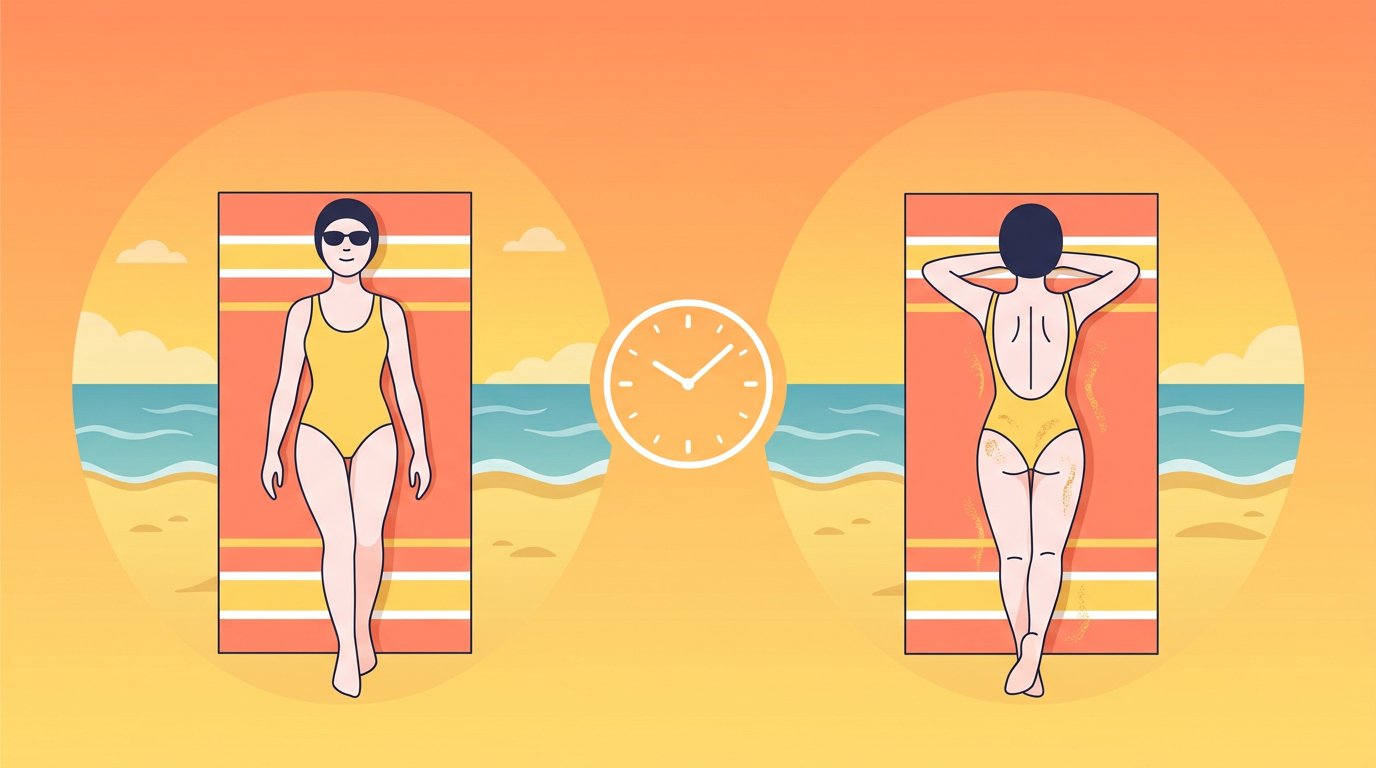
A super common mistake is spending way more time on your front (face up) than your back (face down). It makes sense — lying face down is less comfortable, you can't look at your phone easily, and it's just less enjoyable. But your back needs equal time.
Here's a good rotation schedule for even tanning:
15-20 minutes face up (back on ground, front to sun). 15-20 minutes face down (front on ground, back to sun). 10 minutes each side (lying on left side, then right side).
That's about 50-60 minutes total for a well-rounded, even tan. Set timers for each position — it's the only way to make sure you're actually splitting time evenly.
Position Hacks for Face-Down Time
Face-down tanning doesn't have to be miserable:
Stack your hands under your forehead. This creates a little pocket of air so you can breathe comfortably. Turn your head to the side periodically to avoid neck strain. Use a towel pillow. Roll up a small towel and put it under your forehead for cushioning. Bring a book or tablet. Set it on the ground in front of you and prop up slightly on your elbows. This angles your back toward the sun and gives you something to do. Listen to music or a podcast. Face-down time goes faster with entertainment. Just set that flip timer.
Problem Areas on the Back
Certain spots on your back are notorious for tanning unevenly:
Shoulder blades. These stick up slightly, so they get more UV and can burn faster than the rest of your back. Make sure they get good SPF coverage. Lower back. The curve of your lower back can create a slight shadow, leaving it lighter. When face down, put a thin pillow under your hips to flatten out the curve. Sides/flanks. The transition from back to sides often gets missed. Spend dedicated time on each side to blend this area. Bra strap area. If you tan with a bikini top, the straps create lines. Consider strapless tanning or moving your straps periodically to minimize obvious lines.
Advanced: The Back Check
Since you can't easily see your back, here's how to monitor progress:
Take a selfie of your back with your phone over your shoulder after each session. Compare weekly to see if you're developing any uneven spots. This helps you adjust positioning and sunscreen application before patches become major issues.
If you notice one area is darker or lighter, adjust your position during the next session. Slightly angling your body can direct more or less UV to specific areas.
If Your Back Is Already Uneven
Already dealing with a patchy back tan? Here's how to fix it:
Exfoliate the darker patches. Gentle exfoliation in the shower helps even things out by removing extra dead skin from the over-tanned areas. Self-tanner on lighter spots. A gradual self-tanner applied to the lighter areas can help blend everything together. Time fixes most things. As you continue tanning with better technique, the uneven areas will gradually blend as lighter spots catch up.
Your back deserves the same attention as your front. With spray sunscreen, equal timing, and smart positioning, you'll have a back tan that matches the rest of you.
Learn more: How Long to Tan Each Side | Essential Tanning Tips
The Buddy System Advantage
If you have a friend, sibling, or partner willing to help, the back tanning problem becomes much easier. Have them apply your back sunscreen in long, even horizontal strokes from shoulders down. This gives even coverage that is impossible solo. No streaky sunscreen equals no streaky tan.
Ask them to check your back after 10-15 minutes. Are any areas pinker than others? Is sunscreen still visible or has it absorbed unevenly? A quick mid-session visual check lets you adjust before problems develop.
The Pillow and Prop Method
When tanning solo face-down, your body's natural curves create shadows and uneven UV exposure. Simple props fix this:
Thin pillow under hips: Flattens the lower back curve. Without it, your lower back sits in a slight shadow created by your butt and upper back. A thin pillow or folded towel eliminates this dip.
Arms at your sides, not under chin: Arms under your chin create shadows on shoulder blades and upper back. Arms at your sides expose your full back.
Slight body angle: Rather than lying perfectly flat, tilt your body 10-15 degrees to one side. This catches the side of your back that would otherwise self-shadow. After 10 minutes, tilt slightly to the other side. This small adjustment makes a surprising difference.
Tracking Progress Over Time
Back selfie after every session in the same lighting. Compare weekly, not daily — day-to-day changes are too subtle. Note your session details so you can adjust if certain areas fall behind.
Use our tanning calculator and skin type quiz for precise timing. Your back can look just as evenly tanned as your front — it just takes intentional effort with spray sunscreen, equal timing, smart positioning, and regular progress checks.
The Towel Method for Solo Back Sunscreen
If spray sunscreen is not available and you are tanning alone, here is the towel method for applying lotion sunscreen to your back:
Step 1: Squeeze a generous line of sunscreen onto a clean, thin towel. Not a thick beach towel — a thin hand towel or face cloth works better.
Step 2: Hold the towel by both ends behind your back, like you are drying your back after a shower.
Step 3: Pull the towel side to side in slow, overlapping horizontal passes. Start at the shoulders and work down to your lower back. The sunscreen on the towel transfers evenly to your skin.
Step 4: Repeat with a second application of sunscreen on the towel for any areas you missed. Check in a mirror or take a selfie to verify coverage.
This method is not as good as spray sunscreen, but it is significantly better than the awkward over-the-shoulder reach that leaves half your back unprotected. For a really thorough job, combine both methods: towel method first for base coverage, then spray sunscreen for touch-ups.
Your back represents about 15-20% of your total skin surface area. Neglecting it means 15-20% of your body looks different from the rest. The effort of proper back coverage pays off every time you wear a backless top, a swimsuit, or a dress that shows your back. Nobody notices an evenly tanned back — but everyone notices a patchy one.
The Lounge Chair Advantage for Back Tanning
If you have access to a lounge chair that reclines, it solves many back tanning problems that flat-on-the-ground positioning cannot:
Adjustable angles. A lounge chair lets you adjust the incline, which changes which parts of your back face the sun most directly. A low recline (almost flat) works best for midday overhead sun. A steeper recline (sitting more upright) works better for morning or afternoon when the sun is at an angle — it tilts your back toward the sun rather than away from it.
No ground shadows. When you lie flat on the ground face-down, the ground itself blocks UV from reaching the sides of your torso and the edges of your back. A raised chair eliminates this by getting your body above ground level, allowing UV to reach from more angles.
Easy flipping. Transitioning from face-up to face-down on a lounge chair is trivial — just roll over. On the ground with towels and pillows and products arranged around you, flipping is a whole production. The easier flipping is, the more likely you are to actually do it on schedule.
Comfort. Face-down on a lounge chair with your face fitting into the headrest area is significantly more comfortable than face-down on a towel on the ground. More comfort means you actually stay in position for the full allotted time rather than cutting it short because your neck hurts.
If you are serious about back tanning, a basic folding lounge chair (available for $20-40 at any big box store) is one of the best investments you can make. It turns back tanning from a struggle into a comfortable, effective routine. Your back tan will show the difference within two weeks.