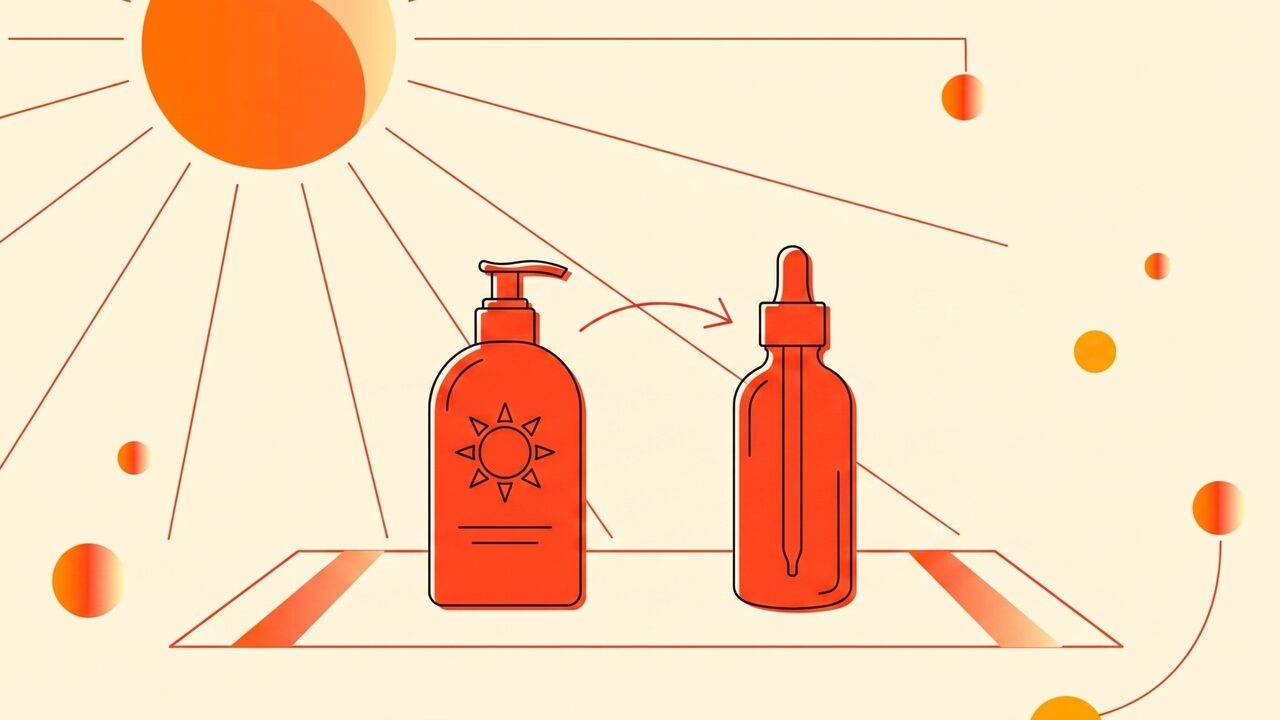
Sunscreen goes on first, always. Wait about fifteen minutes for it to bind to your skin, then apply tanning oil on top if you're using one. Putting oil on first, or mixing the two together in your hand, dilutes the sunscreen and lets UV through before it has had a chance to set.
This question comes up constantly, and the confusion makes sense: sunscreen blocks UV and tanning oil is supposed to help you tan, so it feels like they should cancel each other out. They don't, if you use them in the right order and understand what each one actually does.
Why order matters: how sunscreen actually works
Chemical sunscreens need time to form an even film and start absorbing UV before they're at full strength — most labels recommend applying 15 to 30 minutes before sun exposure. Mineral sunscreens (zinc oxide, titanium dioxide) work faster since they sit on the surface reflecting light, but they still need to form a continuous layer to work properly.
If you apply oil first, you create a slick layer that the sunscreen then has to sit on top of or mix into. Either way, you get an uneven film with gaps, and gaps in sunscreen coverage are where burns start. Applying oil after the sunscreen has had time to set avoids this — the oil sits on top of an already-formed protective layer instead of interfering with it.
The right layering order
- Sunscreen first, applied generously and evenly to all exposed skin.
- Wait 15 minutes before going into direct sun, so the sunscreen has time to set.
- Tanning oil on top, if you're using one, for the sheen and any accelerator ingredients.
- Reapply sunscreen every two hours, or immediately after swimming or heavy sweating — oil does not extend how long sunscreen lasts.
For step-by-step technique on the oil itself, see how to use tanning oil.
Why tanning oil with SPF still isn't "enough" protection alone
Plenty of tanning oils advertise an SPF number, usually low — SPF 4, 6, or 15. That is real protection, but it is thin protection, and oils are formulated to spread in a much thinner film than a dedicated sunscreen. A thin film means you get less than the labeled SPF in practice, because SPF testing assumes a specific, generous application amount that most people don't match with oil.
If you want meaningful protection while still getting the tanning-oil sheen, use a real sunscreen underneath at the SPF you actually need, and treat the oil's built-in SPF as a bonus, not your main defense. For guidance on picking numbers, read the best sunscreen for tanning and can you tan with SPF 50.
Does oil "cancel out" sunscreen?
Not chemically, no. Sunscreen filters work by absorbing or reflecting UV wavelengths regardless of what sits on top of them, as long as the layer itself is intact. What can weaken sunscreen is applying oil first and rubbing it in aggressively, which can drag the sunscreen layer around unevenly, or applying such a thick layer of oil that you effectively wipe off sunscreen while smoothing the oil on. Apply oil with a light hand, on top, after the sunscreen has set, and this isn't a real issue.
Reapplication: the part people skip
This is where most sun protection actually fails, oil or no oil. Sunscreen breaks down under UV exposure and rubs off from towels, sand, and swimming. It needs reapplying roughly every two hours during active sun exposure, and immediately after swimming or heavy sweating, regardless of what the label's water-resistance claim says.
The order for reapplication is the same as the first application: sunscreen, wait if you can, then oil on top again if you want the sheen back. Skipping the sunscreen step on reapplication because "the oil is still on" is one of the most common ways people end up burned despite thinking they were protected all day.
What if you don't want to layer two products?
Some tanning oils are formulated as combined sunscreen-oil products with a real, tested SPF rather than a token number. These are simpler because there's no layering order to think about — you apply once. The tradeoff is that combined products are harder to reapply generously without feeling greasy, so check the actual SPF number rather than assuming a "tanning oil sunscreen" is automatically adequate. See the best tanning oil and sunscreen combos for options that test well.
A note on burning while using oil
Because oil makes skin glossy and can accelerate how quickly it warms in the sun, people sometimes tan faster with oil and mistake early color for safety, skipping reapplication. Faster visible color doesn't mean you're less likely to burn — it can mean the opposite, since a glossy surface reflects light around your skin as well as onto it. Keep an eye on UV index and time in sun rather than judging by how fast you're getting color. A UV tracking app like TanAI can help time sessions so you're not relying on guesswork.
Frequently asked questions
Does tanning oil cancel out sunscreen?
No, not chemically. What causes problems is applying oil before sunscreen has set, or applying it so thickly that you disturb the sunscreen layer underneath. Apply sunscreen first, wait 15 minutes, then oil on top.
Can I mix sunscreen and tanning oil together in my hands before applying?
It's better not to. Mixing dilutes both products and makes it harder to get an even, full-strength layer of either. Apply them separately, sunscreen first.
Is SPF 15 tanning oil enough protection on its own?
For short exposure at low UV, it may be adequate, but oils are usually applied thinner than sunscreen testing assumes, so the real-world protection is often lower than the label suggests. For longer or more intense sun, use a dedicated sunscreen underneath.
Do I need to reapply sunscreen if I'm wearing tanning oil?
Yes, on the same schedule as without oil — roughly every two hours, and immediately after swimming or heavy sweating. Oil does not extend sunscreen's protection window.
Should I apply oil before or after going in the water?
Apply both sunscreen and oil before you go in, and reapply both once you're out and dry, since water removes a meaningful amount of each regardless of water-resistance claims.
Bottom line
Sunscreen first, wait 15 minutes, tanning oil on top — that's the order, and it's simple once you know why. The two products don't fight each other chemically; the problems come from applying them in the wrong sequence or skipping reapplication because the oil is still visible on your skin. Treat any SPF in the oil as a bonus, not your main protection, and reapply both every two hours to stay ahead of burning.