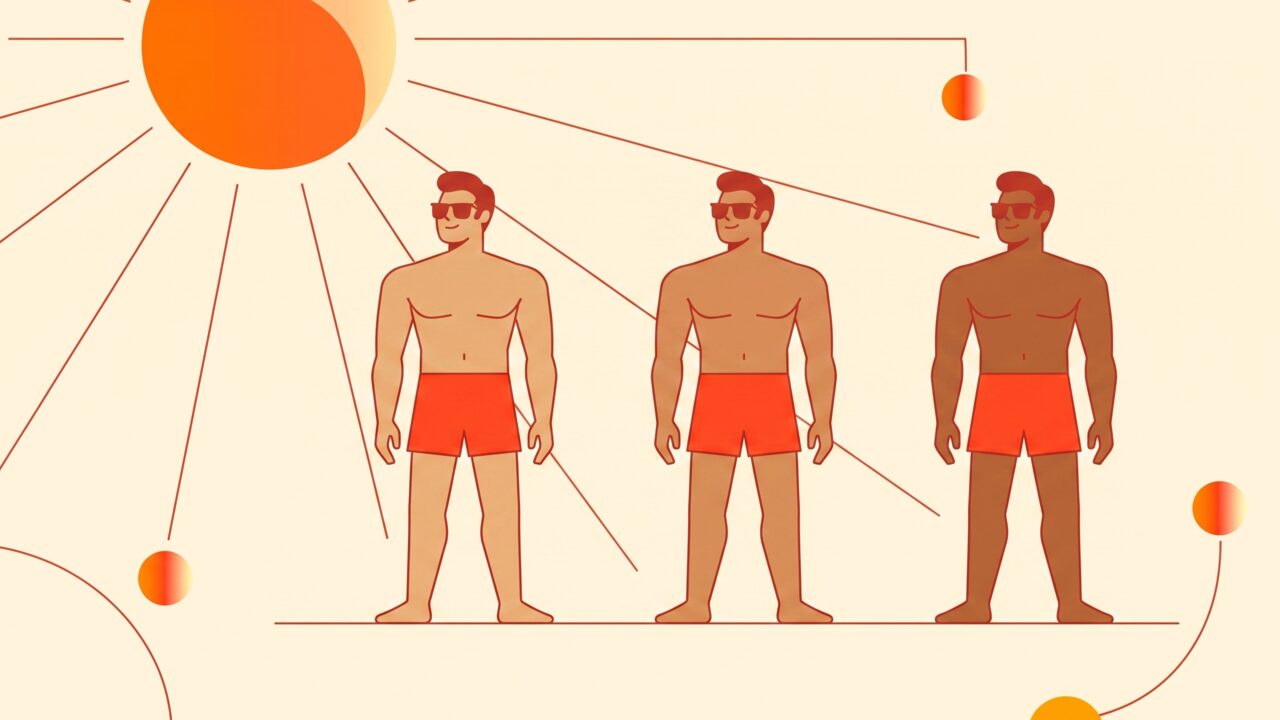
You stop getting darker because your skin has a genetic ceiling on how much melanin it can produce, and once you hit it, additional sun exposure doesn't add more color — it just adds more UV damage without a visible reward. Where that ceiling sits depends mainly on your Fitzpatrick skin type, which is a classification based on how your skin responds to sun, not on effort or technique.
This is one of the more frustrating realities of tanning, because it feels like more sun should always mean more color, and for a while it does — until it doesn't, and people respond by pushing harder instead of recognizing they've reached their limit.
What sets your ceiling: Fitzpatrick skin type
The Fitzpatrick scale groups skin into six types based on natural color and how it responds to UV, originally developed to estimate burn and cancer risk, but it maps closely onto tanning capacity too:
- Type I: very fair, always burns, rarely tans — the ceiling here is low and the sunburn risk is high before much color develops.
- Type II: fair, burns easily, tans minimally — a modest ceiling, reached fairly quickly.
- Type III: medium, burns moderately, tans gradually — a middle ceiling reached over repeated sessions.
- Type IV: olive, burns minimally, tans well — a higher ceiling with more room to darken.
- Type V: brown, rarely burns, tans deeply — a high ceiling reached over a longer stretch of consistent exposure.
- Type VI: deeply pigmented, almost never burns — melanin production is already high baseline, with further darkening still possible but proportionally smaller.
Your type isn't a lifestyle choice, it's genetics — the amount and type of melanin your melanocytes are built to produce. Lighter types have a lower ceiling not because they're "not trying hard enough," but because their melanocytes are wired to produce less pigment even at maximum response, and to burn at lower UV doses along the way. See tanning for brown skin and tanning tips for pale skin for type-specific approaches.
Why more sun past the ceiling only adds damage
Melanin production isn't unlimited — it follows a response curve that flattens out. Once your melanocytes are producing at their maximum sustainable rate for your genetic type, throwing more UV at your skin doesn't push production higher. What it does instead is keep accumulating the same DNA damage that triggered melanin production in the first place, at a point where your skin's defense mechanism has already maxed out its response.
That means the marginal sun exposure past your ceiling has a worse risk-to-reward ratio than the sun exposure that got you there. Early sessions build real color for real UV received. Sessions after you've plateaued mostly just accumulate risk — sunburn on already-color-saturated skin, and the cumulative DNA damage linked to premature aging and skin cancer risk — for little to no visible gain.
How do you know you've hit your peak?
The clearest sign is a session that used to reliably deepen your color no longer producing a visible change after a few days, even though your routine, UV exposure, and skin condition are the same as when you were still progressing. If you compare photos from a week or two ago to now and the color looks essentially identical despite continued sun sessions, you're very likely at or near your ceiling for this stretch of the season.
Peaks aren't necessarily permanent forever — skin's baseline pigment can shift over a season with sustained exposure, and it resets somewhat over winter or extended time out of the sun. But within a given period of consistent tanning, there's a real point of diminishing returns, and pushing past it changes your risk profile more than your color.
Holding your peak instead of chasing darker
Once you're at your ceiling, the smart move shifts from "how do I get darker" to "how do I keep this color and minimize further damage." That's a genuinely different, and easier, goal:
- Reduce session frequency and intensity — maintenance needs less UV than building did. You don't need to keep tanning as hard once you're not gaining color from it.
- Moisturize consistently — since your tan lives in cells that will eventually shed, keeping skin hydrated slows how fast those cells turn over and the color fades. See how to stay tan and how to keep your tan from fading.
- Prioritize sunscreen more, not less — you're no longer trading exposure for visible progress, so there's less reason to accept burn risk for marginal, invisible gains.
- Watch for signs of overexposure — peeling, deepening redness under the tan, or skin that looks damaged rather than colored are signs you've been pushing past your ceiling rather than maintaining it.
A UV tracking app like TanAI can help shift your sessions toward maintenance-level exposure once you notice you've plateaued, rather than defaulting to the same intensity that got you there.
Does everyone eventually plateau, even darker skin types?
Yes, in the sense that everyone's melanin production has some ceiling — but higher Fitzpatrick types generally have both a higher ceiling and a slower, more gradual approach to it, so the plateau is less abrupt and sits at a darker point. Lower Fitzpatrick types often hit their ceiling faster and at a more modest color, which is part of why very fair skin sometimes seems to "cap out" at a light tan no matter how much sun is involved.
Frequently asked questions
Why did my tan stop getting darker even though I'm still going in the sun?
You've likely reached your genetic melanin ceiling for this stretch, based on your Fitzpatrick skin type. Continued sun at that point mostly adds UV damage rather than visible color.
Can I raise my melanin ceiling with more consistent tanning?
Not meaningfully — your ceiling is set by genetics, not training. What consistent, moderate exposure can do is help you reach your existing ceiling more evenly and hold it longer, not raise it.
Is it more dangerous to keep tanning after I've plateaued?
The risk-to-reward ratio gets worse, yes. You're accumulating the same UV-related DNA damage without the offsetting benefit of new visible color, since your skin's pigment response has already maxed out.
How do I know if I'm at my peak or just tanning slowly?
Compare your color across a week or two of continued, consistent sessions. If it looks unchanged despite similar UV exposure to sessions that used to deepen your color, you're likely near your ceiling rather than just progressing slowly.
Bottom line
Every skin type has a genetic limit on how dark it can get, set by Fitzpatrick type, not by effort. Reaching that ceiling isn't a failure, and pushing past it with more sun trades invisible risk for visible reward you're not going to get. Once you notice your color has plateaued, shift to maintaining it with moderate exposure, moisturizer, and consistent sunscreen rather than chasing a darker result your skin isn't built to produce right now.