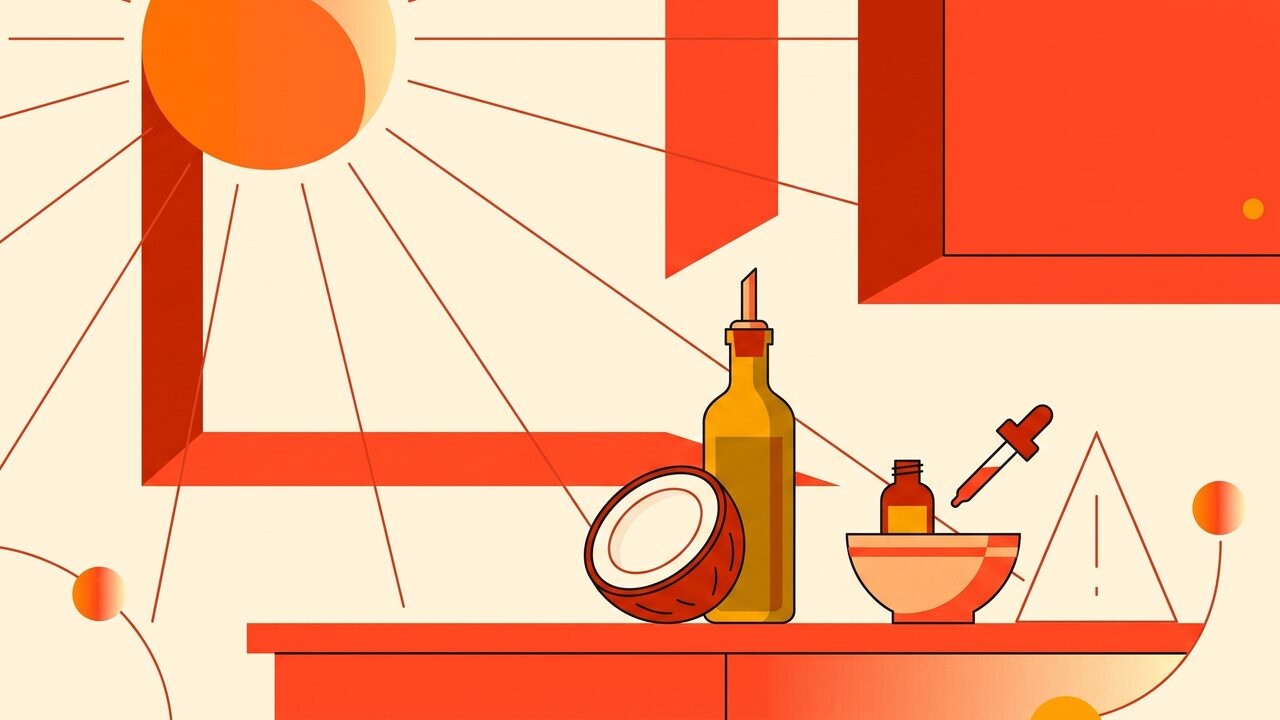
Homemade tanning oils made from kitchen ingredients like coconut oil, olive oil, or carrot seed oil can moisturize skin and make a tan look glossier, but none of them give you meaningful sun protection. Some recipes circulating online — particularly iodine mixed with baby oil — are worth avoiding entirely. Here is what the physics and evidence actually support.
Why oils make skin look more tanned
Any oil on skin does two things relevant to tanning: it reflects and focuses light slightly differently than dry skin, giving a glossier look that many people read as "more tanned," and it keeps skin hydrated, which genuinely helps a tan look more even because dry, flaky skin scatters light unevenly and can peel unevenly too. Neither effect changes how much UV your skin absorbs or how fast melanin forms. The oil is a cosmetic and comfort layer sitting on top of a biological process it does not control.
Coconut oil
Coconut oil is probably the most common homemade tanning oil, largely because it is already a common household moisturizer and smells like a beach vacation. It has essentially no SPF — lab measurements of raw coconut oil generally put any UV-filtering effect at negligible levels, nowhere close to a usable sunscreen number. It moisturizes well and gives a nice glossy finish, which is the whole appeal. Our dedicated guide on coconut oil for tanning goes deeper into what it can and cannot do.
Olive oil
Olive oil behaves similarly to coconut oil in this context: a genuine moisturizer with a pleasant, cooking-cabinet convenience, and essentially no meaningful SPF. Some people find it heavier and greasier than coconut oil and more prone to a lingering scent. It carries the same core limitation — it will not stop you from burning.
Carrot seed oil: the "natural SPF" myth
Carrot seed oil is the one homemade ingredient with a genuine internet reputation as a "natural sunscreen," sometimes cited with a specific SPF number pulled from lab studies. This claim does not hold up to scrutiny. The lab studies behind the claim tested oil under controlled conditions that do not match how oil behaves spread thinly on skin in the sun, and no dermatology body recommends carrot seed oil as a substitute for tested, regulated sunscreen. Treat any SPF number attached to carrot seed oil online as unreliable, not as a real, tested rating you can plan sun exposure around.
If you like the smell or the cosmetic feel of carrot seed oil, use it as an additive to a moisturizer, not as your sun protection strategy.
Cooking oils and other pantry ingredients
Sunflower oil, vegetable oil, and similar cooking oils occasionally show up in forum recipes. They function the same way as coconut and olive oil — moisture and gloss, no real UV filtering — with the added downside that they are not formulated for skin use and can be more likely to cause breakouts or irritation, especially on the face. There is nothing here worth the mess or the risk beyond what a proper tanning oil already offers.
The iodine and baby oil recipe: skip it
A long-running piece of tanning folklore recommends mixing iodine into baby oil to "boost" tanning. This recipe is worth calling out directly as a bad idea. Topical iodine at tanning-forum concentrations can irritate and stain skin, and there is no credible mechanism by which it increases melanin production from the outside — melanin synthesis happens in response to UV damage signals inside skin cells, not from an iodine compound sitting on the surface. Baby oil itself carries the same no-SPF limitation as any other oil. Combining the two adds an irritation risk for zero real tanning benefit. Our baby oil safety guide covers the plain baby oil question in more depth; the iodine addition only makes things worse.
The physics you actually need to know
UV damage to skin depends almost entirely on UV dose — intensity times time — and your skin's own melanin and how much of a filter you put between your skin and the sun. Oil is not a filter. It sits on skin without meaningfully blocking or absorbing UVB or UVA wavelengths, which is why lab-tested SPF numbers for pure oils are so low. If a recipe or product claims oil alone gives "natural protection," ask what SPF number that claim is based on and whether it comes from a real, standardized SPF test — most homemade claims do not.
This is also covered from a broader angle in our tanning myths debunked guide, which addresses several other claims in the same family as "natural sunscreen oils."
If you're going to use a homemade oil anyway
If you want the moisturizing feel of coconut, olive, or another kitchen oil while tanning, the safer approach is straightforward: apply a real, tested sunscreen first, let it absorb, then use your homemade oil as a lighter top layer for feel and shine. Keep sessions in moderate UV rather than the strongest midday sun, and reapply your actual sunscreen on its normal schedule — the oil layer does not need reapplying as often, but your sun protection does. This mirrors the approach in our guide to using tanning oil for commercial products.
Frequently asked questions
Does any homemade oil actually have SPF?
No common kitchen oil — coconut, olive, sunflower, or otherwise — offers meaningful, reliable SPF. Any specific number you see quoted online for a pure oil should be treated with skepticism.
Is carrot seed oil really a natural sunscreen?
No. The claim is popular but not supported by real-world testing that matches how thinly oil sits on skin outdoors. Do not plan sun exposure around it.
Is the iodine and baby oil mix dangerous?
It offers no real tanning benefit and adds a real risk of skin irritation and staining. There is no good reason to use it over plain baby oil or a proper tanning oil.
Can homemade oil make me tan faster?
No oil speeds up melanin production, which depends on UV exposure and your skin type. What oil can do is keep skin hydrated and give a glossier finish, which sometimes makes a real tan look a bit more even.
Bottom line
Homemade tanning oils are moisturizers with good marketing, not sun protection. Coconut and olive oil are fine for the feel and shine if you layer them over real sunscreen. Carrot seed oil's "natural SPF" reputation does not hold up. Skip the iodine and baby oil recipe entirely — it adds risk without any real benefit. If you want a controlled, lower-risk tan, pair any homemade oil with actual sunscreen and moderate UV, and track your session with a UV-aware tool like TanAI rather than guessing.