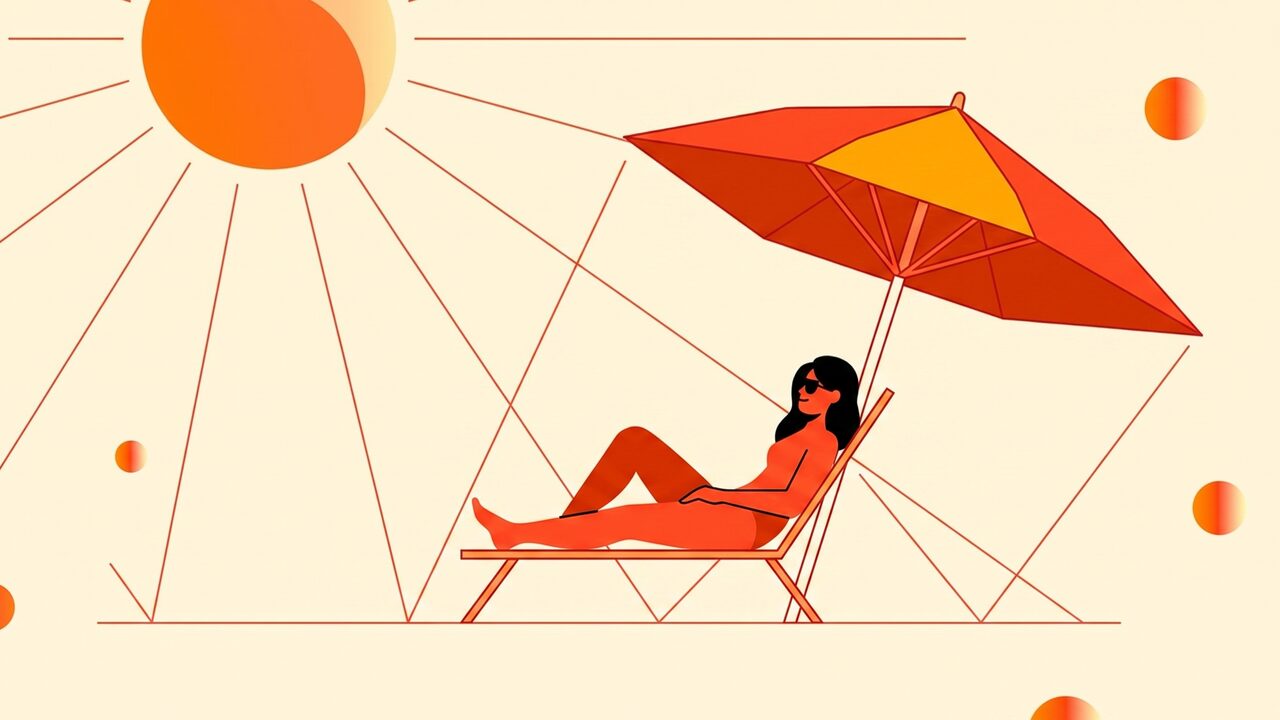
Yes, you can tan in the shade, just more slowly. UV light does not travel in a single straight beam from the sun to a single spot — a large share of it scatters off the sky and reflects off surfaces like sand, water, and pale concrete, and that scattered and reflected UV still reaches skin that's sitting under an umbrella or a tree.
This surprises people because shade feels protective, and it is — just not completely. Understanding how much UV still gets through helps you use shade properly, either to build color slowly or to manage how much sun you're getting on a long day out.
Why shade isn't a full block
Sunlight reaching the ground is a mix of direct UV coming straight from the sun and diffuse UV that has scattered off air molecules, clouds, and particles across the whole sky. On a clear day, roughly 10 to 20 percent of the UV hitting an open patch of ground is diffuse rather than direct, and diffuse UV comes from all directions, including the parts of the sky not blocked by your umbrella or tree canopy.
Stand under a beach umbrella and you block the direct beam, but you're still standing in a wide-open space under a sky that's scattering UV down at you from every angle the umbrella doesn't cover — which is most of it, since an umbrella only shades a cone, not a dome. That's why people who sit under umbrellas all day at the beach still often come home with some color.
Reflection adds even more
Bright surfaces bounce UV back up, and this matters a lot more than most people expect:
- Dry sand reflects roughly 15-25 percent of UV back upward.
- Water reflects around 10-25 percent depending on the angle of the sun, more at low sun angles.
- Concrete and pale paving reflect a meaningful amount too, which is why light color under a shaded pool deck still adds up.
- Snow reflects up to 80-90 percent, far higher than any beach surface, which is why skiers burn badly on overcast days.
Sit in the shade at the beach and the sand around you is still bouncing UV up at your legs and the underside of your arms from below, an angle an umbrella does nothing to block.
How much slower is tanning in the shade?
There's no single universal number, since it depends on how dense the shade is, what's around you reflecting light, and the UV index that day. As a rough guide, well-shaded skin at the beach might be getting somewhere in the range of a third to half the UV dose of skin in full open sun, largely from diffuse sky light and ground reflection. That's enough to build color over a longer stretch of time, just at a noticeably slower rate than direct sun exposure.
Tree shade tends to block more than an umbrella if the canopy is dense, since leaves scatter and absorb more light than the tight cone an umbrella covers, but dappled shade under a thin canopy lets through patches of direct sun that add up more than people realize over a few hours.
Umbrella UPF matters
Not all umbrellas are equal. Fabric that's been rated with a UPF (ultraviolet protection factor) number blocks meaningfully more UV than plain cotton or a loosely woven beach umbrella. A UPF 50 umbrella blocks about 98 percent of the UV that hits its fabric directly — but again, that only covers the direct beam through the canopy, not the diffuse and reflected UV coming in from the sides and below.
If you want real, low sun exposure rather than just slower tanning, pair a high-UPF umbrella with sitting further back from open sand and water, since that reduces how much reflected light reaches you as well.
Using shade as a safety tool, not just a slower tan
This is the more useful way to think about shade: it's a dial, not a switch. On a high UV index day, moving into shade partway through your time outside is a genuinely effective way to keep building some color while cutting your burn risk, rather than an all-or-nothing choice between full sun and staying inside.
- On very high UV days, plan sun blocks with shade breaks rather than one long stretch in the open.
- Shade extends how long you can comfortably stay outside without needing to add more sunscreen as often, since your dose is lower.
- It doesn't remove the need for sunscreen — reflected and diffuse UV still cause burns over a long day, just more slowly.
For the mechanics of building color at a safe rate in open sun as well, see how to tan without burning and the best UV index for tanning. A UV tracking app like TanAI can show you the live UV index so you know roughly what dose you're getting even while sitting under an umbrella.
Frequently asked questions
Will I tan at all if I stay under an umbrella the whole day?
Yes, some. Diffuse sky light and reflection off sand or water still reach shaded skin, so you'll likely see some color build up over a full day, just slower than in direct sun.
Does sitting in the shade mean I don't need sunscreen?
No. Diffuse and reflected UV can still cause a burn over several hours, especially at the beach or pool where sand and water bounce extra light at you. Wear sunscreen even in shade on sunny days.
Is tree shade better than an umbrella for reducing tan?
Usually, if the canopy is dense, since leaves scatter and absorb more UV than a tight umbrella cone. Thin or patchy tree shade lets through direct sunbeams that can add up more than expected.
Why did I get sunburned even though I was mostly in the shade?
Reflection is the usual culprit — sand, water, and pale pavement bounce UV up at skin that an overhead umbrella or canopy doesn't block from below or the sides. A long day near reflective surfaces adds up even with mostly-shaded skin.
Does cloud cover work like shade for tanning purposes?
Somewhat, though the two aren't identical. Clouds scatter and absorb some UV depending on thickness, but a lot of UV still passes through, especially on hazy or thin cloud days, which is why people commonly burn on overcast days when they assumed the cloud was doing more blocking than it actually was. Shade from an umbrella or tree tends to be a more consistent, predictable reduction than cloud cover, which changes throughout the day.
Bottom line
Shade slows tanning, it doesn't stop it. Scattered sky light and reflection off sand, water, and pavement all still reach skin under an umbrella or tree, which is why a full day at the beach in the shade still often leaves some color. Use shade as a way to manage how much UV you get on a long day, not as a guarantee you're fully protected — sunscreen still matters underneath it.